AI governance infrastructure
Privacy-first by design

Your board is asking about AI governance. C.L.A.R.A. is your answer.

The only platform that gives enterprises AI governance without surveillance.

Full visibility. Real-time policy enforcement. Zero content surveillance.

Board question Which AI tools are in use, where is the risk, and what controls are actually working?
Operating answer C.L.A.R.A. discovers Shadow AI, detects risky behaviour locally in the browser, and enforces policy in real time.
Trust proof No prompt capture. No page-content capture. No readable employee content stored by default.

C.L.A.R.A. never sees prompts, responses, page content, clipboard text, or file contents.

Metadata only
Local detection
Real-time policy enforcement
Enterprise-ready deployment
0 Readable content stored
0 Governance actions: allow, warn, block
0 Board-level risk areas surfaced
0 Trust layer across browser and dashboard
Governance command surface
Metadata only · Local detection · Multi-tenant admin
Pilot-ready deployment

Shadow AI across the enterprise edge

Approved, unknown, and blocked activity resolved into clean governance events.

26 Tools surfaced
18 Policy events
100% Metadata only

Live tool states

Approved and emerging AI use resolved into policy state.

ChatGPT Enterprise Approved
Unknown model Review
Public chatbot Blocked
Microsoft Copilot Approved

Governance evidence, not surveillance data

Each event retains tool, outcome, timing, and severity. Readable content never leaves the browser.

Policy posture

Source code to public AI Block High-confidence local match. Content never transmitted.
PII to unapproved tool Warn Contextual notice shown before sensitive data leaves the page.
Approved tool usage Allow Structured event supports governance evidence and spend visibility.

Event mix

Local inspection Pattern matching stays in-browser. Metadata only leaves the device.
Shadow AI discovery Unknown tools surface for review, approval, or block policy.
Employee transparency People can see what is recorded and what is never read.
Board-level pressure

Every enterprise now has the same four AI problems.

They surface in security reviews, budget meetings, compliance discussions, and board questions. Waiting does not simplify them.

Discovery gap
01

Invisible usage

Teams are already using AI tools faster than policy can keep pace. Most organisations do not know what is approved, improvised, or entirely unknown.

Shadow AI becomes operational before governance begins.
Governance starts with tool-level visibility.
Control gap
02

Uncontrolled risk

Code, credentials, customer data, and internal references can reach public tools in seconds unless policy works where the behaviour actually happens.

Analytics alone cannot prevent the moment that matters.
Policy has to meet behaviour in the browser.
Capital gap
03

Unjustifiable spend

Approved licences, duplicate tools, and unmanaged experimentation fragment budgets. Finance needs clear visibility into which usage is strategic and which is drift.

Governance and spend discipline are now the same conversation.
Adoption data and spend posture belong together.
Evidence gap
04

Audit exposure

Leaders are asked what controls exist, how policy is enforced, and what evidence can be produced. Informal answers do not survive formal review.

Defensible evidence is becoming a requirement, not an ambition.
Evidence needs to exist before the board asks.
How C.L.A.R.A. works

Govern AI at the point of use, then manage it centrally with evidence.

C.L.A.R.A. is delivered as a lightweight browser companion managed by IT and a cloud-native multi-tenant admin dashboard. Detection happens locally. Governance happens with structured telemetry.

EXT

Browser companion

Managed deployment through enterprise IT with minimal user friction.

LOC

Local detection

Policy-aware matching runs in-browser and discards readable content.

ADM

Admin cloud

Central governance, evidence trails, and role-specific dashboard views.

01

Deploy browser companion

Roll out a lightweight extension through standard enterprise controls. C.L.A.R.A. starts surfacing AI usage and policy events without demanding workflow changes from employees.

IT-managed rollout Low operational lift Pilot-ready today
02

Detect locally, discard content

All pattern matching runs locally inside the browser. C.L.A.R.A. identifies risky behaviours and tool usage, applies policy, and sends only structured event metadata to the backend.

No prompt capture No page-content capture No clipboard-text storage
03

Govern centrally with evidence

Security, IT, compliance, and leadership teams receive the visibility they need: discovered tools, policy outcomes, adoption posture, and defensible governance records across the organisation.

Shadow AI discovery Warn and block flows Executive-ready evidence
Focused product views

Inside the C.L.A.R.A. control plane

Focused product views from the pilot environment across governance posture, policy control, audit evidence, and employee transparency.

CISO Dashboard · Security posture
C.L.A.R.A. CISO dashboard showing risk posture, controls, and unknown AI tool activity.
Security view Live posture, risk concentration, and unknown tools
CISO Dashboard

Risk concentration, unknown tools, and enforcement posture for security leadership

Risk KPIs Unknown tools Policy state

Security teams can move from uncertainty to board-ready control with live visibility into Shadow AI, high-risk activity, and the state of governance coverage.

Real product views from the pilot environment.

The control plane brings forward the operating layer that matters most in each screen: posture, policy, evidence, and employee transparency. Open any view for the full original product screen.

Real screenshots Governance posture Full original view
Privacy architecture

Governance without surveillance. This is not a compromise. It is the design.

C.L.A.R.A. is governance-first, not employee surveillance. The system is built so organisations can prevent risk, surface Shadow AI, and preserve trust at the same time.

What C.L.A.R.A. captures

  • Tool identity, domain, and policy context
  • Structured event type, severity, and outcome
  • Time, tenant, and role-aware governance metadata
  • Evidence that a policy was enforced, warned, or allowed
  • Employee self-view records for transparency and trust

What C.L.A.R.A. never captures

  • Prompts or generated responses
  • Page content or browser screenshots
  • Clipboard text or file contents
  • Readable employee work product
  • Keystroke logs or covert monitoring signals

Local detection, structured telemetry only

All pattern matching runs locally in the browser. The backend receives structured event metadata only. That architecture is the privacy guarantee and the governance model.

Employee transparency is a product feature

C.L.A.R.A. includes an employee self-view so people can see what the system records and what it never reads. Trust is part of deployment, not a footnote for legal review.

GDPR Article 25 Metadata Only Employee Transparency by Design
Detection surface

What C.L.A.R.A. detects without ever storing readable content

Detection categories are enforced locally in the browser and resolved into governance outcomes. The platform remains precise without becoming invasive.

Warn

File upload attempts

Policy can intervene when sensitive documents are pushed toward external AI tools.

Warn path · approved alternatives can be suggested
Block

API keys and credentials

High-confidence credential patterns can trigger immediate real-time prevention.

Critical local match · block before submission
Warn

Source code

Engineering activity can be governed without capturing the source itself.

Engineering policy · readable code never stored
Warn

PII

Personally identifiable information patterns can route users toward safer approved tools.

Contextual guidance · structured event only
Block

Payment card data

Controls can stop regulated data classes before they move into public model contexts.

Regulated-data class · immediate prevention
Block

Cloud credentials

Local inspection recognises cloud secret patterns and enforces immediate policy.

Secret pattern family · local decision
Warn

Bulk paste patterns

Large transfers into AI interfaces can be checked for policy relevance before submission.

Behavioural cue · reviewed before send
Block

Database dumps and customer lists

Structured indicators help prevent large-scale exposure without storing the underlying data.

High-volume signature · block path
Observe

Shadow AI discovery

Unknown tools surface quickly so administrators can review, approve, or block them.

Unknown domains surfaced as governance inventory
Warn

Internal references

Enterprise-specific markers can support governance policy without reading the work itself.

Enterprise markers · warn without capture
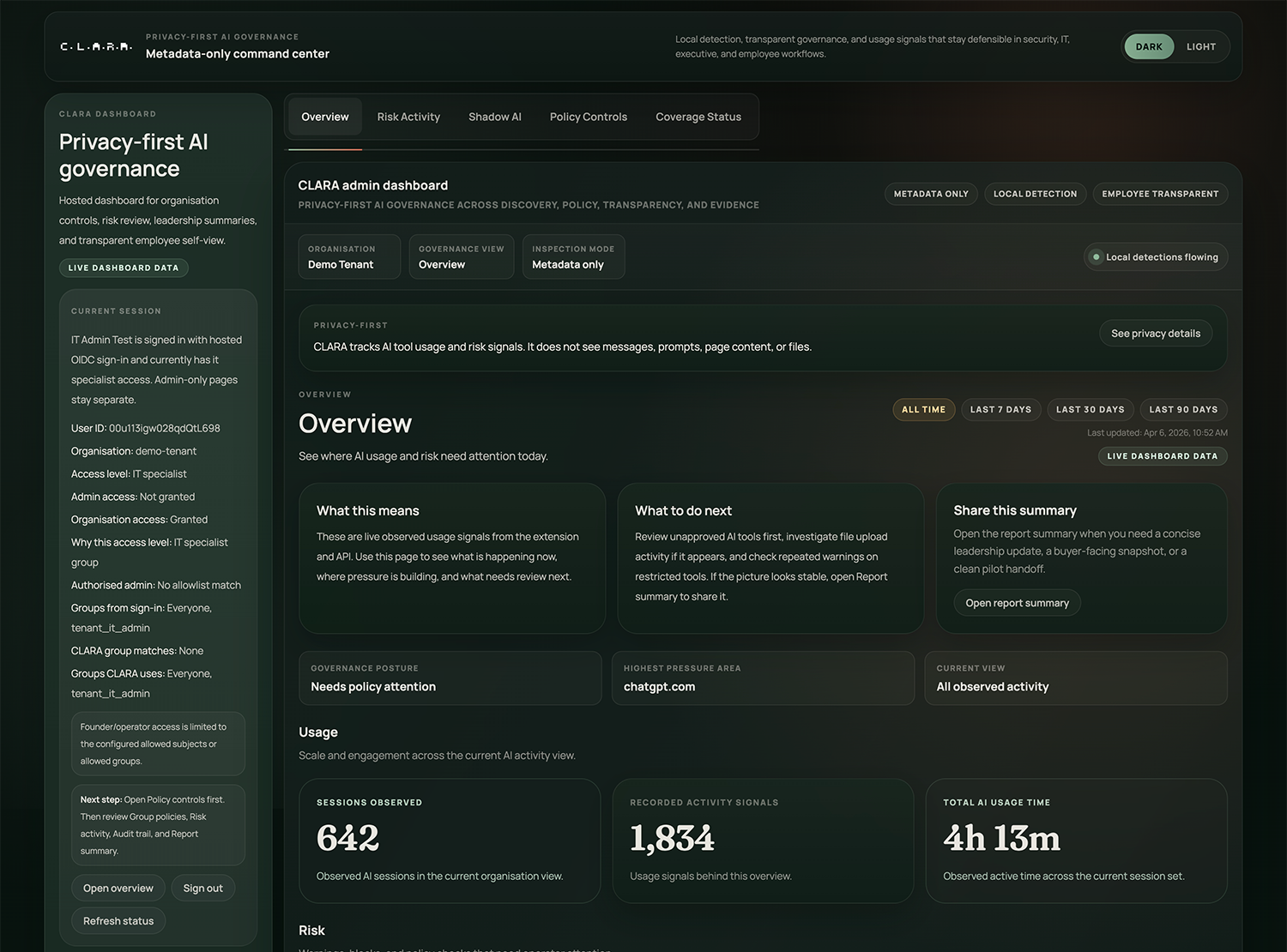
Product dashboards

A governance dashboard built for operators, leadership, and trust.

C.L.A.R.A.'s dashboard is multi-tenant, role-aware, and polished across security, IT, compliance, finance, and employee transparency workflows.

C.L.A.R.A. admin dashboard
Privacy-first AI governance across discovery, policy, transparency, and evidence
Metadata only Local detection Pilot-ready
Tenant NorthBridge Capital
Governance view All departments
Inspection mode Metadata only
Local detections flowing
Tenant posture Controlled adoption
Highest pressure area Unknown tools in finance
Last policy sync 2 minutes ago
Detected tools 26
Warn events 14
Blocked events 4
Policy coverage 91%

Tool usage trends

68%

Approved tool share

Unknown tools, blocked tools, and approved environments stay visible in one governance view.

Department posture

Engineering Approved copilots active · source code policy enforced locally
Managed
Finance Unknown tool activity surfaced · stricter data classes applied
Review
Legal Public-model usage constrained · evidence collection live
Strict

Recent policy activity

08:42 Source code pattern warned on public model Warn
09:15 Unknown AI tool discovered in finance workflow Review
10:06 Credential pattern blocked before submission Block
Who C.L.A.R.A. is built for

Built for the teams being asked to get AI under control.

C.L.A.R.A. gives each stakeholder the signal they need without turning governance into a surveillance programme or a reporting burden.

CISO / Security

Prevent risk before it leaves the browser.

Worried about

Shadow AI, credential leakage, unmanaged external tools, and unverifiable control claims.

C.L.A.R.A. gives them

Real-time local detection, enforceable policy, and structured evidence that controls were actually applied.

Why it matters now

Security teams need a trustable control surface before AI usage becomes impossible to unwind.

IT Director

Deployable governance with minimal operational drag.

Worried about

Rollout complexity, unmanaged tool sprawl, and requests for visibility that create support burden.

C.L.A.R.A. gives them

A lightweight extension, centralised policy, and role-aware dashboards that fit standard enterprise administration.

Why it matters now

IT becomes the operating layer between enthusiastic adoption and board-level accountability.

CFO / Finance

AI spend visibility with governance discipline attached.

Worried about

Duplicate licences, unmanaged procurement, unapproved external usage, and budget drift without clear value.

C.L.A.R.A. gives them

Visibility into tool adoption posture and the governance context needed to rationalise spend.

Why it matters now

Finance is increasingly expected to judge AI exposure, not just software cost.

Compliance & Legal

Defensible evidence without creating a privacy problem.

Worried about

Regulated data movement, employee trust, audit readiness, and systems that gather more than they should.

C.L.A.R.A. gives them

Privacy-by-design architecture, transparent evidence records, and governance without prompt or content capture.

Why it matters now

The governance system itself must be defensible, not merely the policy it claims to enforce.

Trust by design

Employees should trust the governance layer too.

The company learns what it needs to govern AI use without reading employee work. That distinction is the product line C.L.A.R.A. refuses to cross.

  • Employee self-view shows exactly what is recorded and why.
  • Managers do not receive prompt transcripts, page contents, or hidden surveillance feeds by default.
  • Governance outcomes stay legible enough to explain internally and defend externally.

What managers do not get by default

  • No prompt text archive
  • No response archive
  • No page-content replay
  • No screenshot history
  • No clipboard text storage

Why that matters

  • Employees can work with clarity instead of suspicion.
  • Privacy and legal reviews begin from a stronger architectural position.
  • C.L.A.R.A. remains a governance system, not an employee monitoring product.
Pilot programme

Join the C.L.A.R.A. Pilot

We are working with select organisations that want to establish a credible AI governance layer before the category hardens around surveillance-heavy approaches.

  1. 30-day pilot scope

    Focused deployment to a defined user group with Shadow AI discovery, policy review, and live warn or block flows.

  2. Structured onboarding

    Implementation guidance for IT, governance calibration for security and compliance, and employee transparency framing from day one.

  3. Governance review at close

    Leadership-ready summary of usage posture, policy outcomes, and next-stage governance recommendations.

Pilot requests are reviewed directly. C.L.A.R.A. is currently prioritising organisations with immediate governance needs.

Request received.

We’ll be in touch within one business day.

Roadmap

Built for today’s governance needs. Architected for where this is going.

C.L.A.R.A. is already credible in pilot mode. The roadmap extends that foundation rather than replacing it.

Phase 1 — Shipped

Shadow AI visibility and local policy outcomes

  • Browser companion deployment model
  • Shadow AI discovery surfaced in dashboard
  • Warn and block flows functioning
  • Polished multi-role admin views
Phase 2 — Active

Operational depth for enterprise governance teams

  • Richer policy tuning by team and workflow
  • Expanded governance evidence views
  • Sharper administrative review flows
  • Broader visibility across AI usage categories
Phase 3 — Roadmap

Deeper governance intelligence and operating controls

  • More advanced risk classification layers
  • Extended approval and exception workflows
  • Role-specific governance reporting surfaces
  • Expanded deployment and control integrations
Phase 4+ — Vision

The trust layer for enterprise AI adoption

  • Persistent governance context across enterprise AI environments
  • Compounding behavioural telemetry as a defensibility moat
  • Privacy-first standards for enterprise AI trust
  • Board-level governance infrastructure, not point controls
For investors

C.L.A.R.A. is building the AI governance trust layer.

This is a category-creation opportunity at the intersection of security infrastructure, governance software, and enterprise AI adoption.

Privacy-first architecture is not a brand position. It is a structural moat. Behavioural telemetry compounds the more enterprises govern AI at the edge. The result is a platform that can define how serious organisations adopt AI without crossing into surveillance.

The companies that win in enterprise software own the trust layer.
Investor enquiry →

Structural moat

C.L.A.R.A.'s metadata-only, local-detection model is difficult to replicate cleanly once competitors have built around content capture and surveillance assumptions.

Compounding defensibility

Behavioural telemetry across tools, policy states, and enterprise roles becomes more valuable as governance matures across customers.

Category creation

C.L.A.R.A. is not a thin analytics layer. It is a new operating category for AI governance without surveillance.

Board relevance

The product sits directly inside enterprise conversations about risk, spend, control, and defensible adoption. That is where enduring platforms are built.